

Introduction: Why Nature Sales Careers Are Thriving in 2026
Have you ever felt like your day job doesn’t match what you care about? Maybe you want work that helps the planet instead of just paying the bills. If that sounds familiar, you are not alone. More people than ever are searching for nature careers that let them make a real difference. And here is the exciting part: the green job market is booming right now.
In 2026, clean energy jobs are growing at a rate of 2.8 percent, which is faster than overall job growth in the United States.

The Environmental and Energy Study Institute (EESI) reports that climate jobs are clearly on the rise. Between 2024 and 2025, green hiring jumped by 7.7 percent, nearly double the growth of green skills in the workforce.
The Bureau of Labor Statistics projects that employment in the sector related to environmental goods and services will grow 8.4 percent by 2034, almost three times faster than the average. That means companies focused on sustainable products and services are actively looking for people to help them grow.
Sales professionals are the bridge between these nature-focused businesses and the customers who want to support them. Whether you are selling solar panels, organic landscaping, or eco-friendly cleaning supplies, your work directly connects people with solutions that matter. This guide pulls together everything you need to know to break into nature sales in 2026. If you are a job seeker, a career switcher, or someone who wants to work remotely, you will find practical steps here.
Ready to explore how to find real opportunities? Start by learning how to spot legitimate sales jobs with this guide on how to find sales jobs in 2026 without getting scammed. Then keep reading to discover the skills, industries, and strategies that will help you land a nature career you love.
Understanding the Nature Sales Landscape
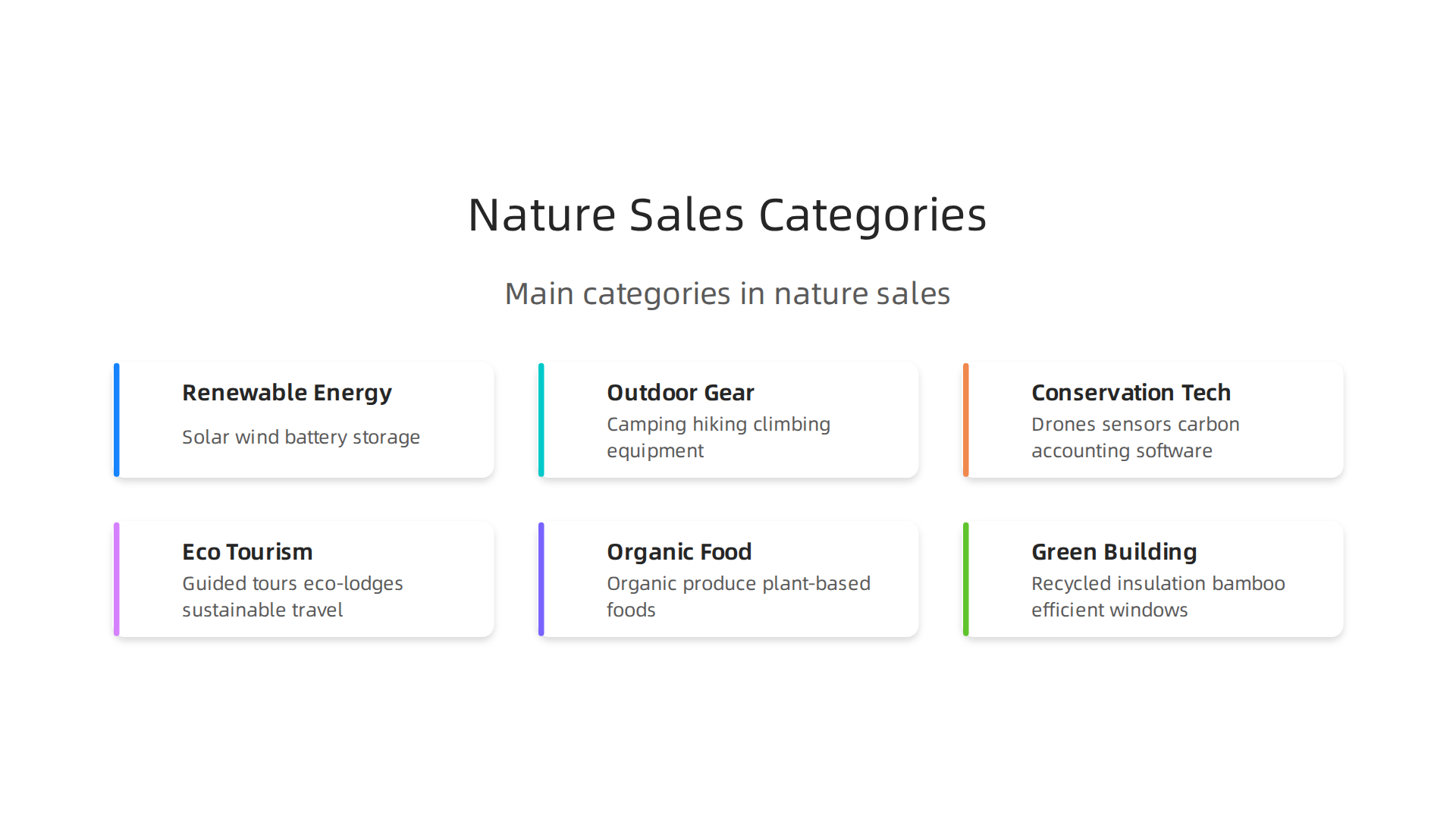
The world of nature sales is much bigger than you might guess. It is not just one type of job. Actually, there are many different kinds of roles that fall under the umbrella of nature careers. Here are the main categories you will find:
- Renewable energy sales: Selling solar panels, wind turbines, battery storage systems, and energy contracts to homes and companies.
- Outdoor gear and apparel sales: Selling camping equipment, hiking boots, climbing gear, and clothing for outdoor adventures.
- Conservation technology sales: Selling tools like drones for wildlife tracking, sensors for air and water quality, and software for carbon offset accounting.
- Eco-tourism sales: Promoting travel packages that focus on nature, such as guided wildlife tours, eco-lodges, and sustainable travel experiences.
- Organic and sustainable food sales: Selling organic produce, plant-based foods, and responsibly sourced ingredients to grocery stores, restaurants, and distributors.
- Green building materials sales: Selling products like recycled insulation, bamboo floors, energy-efficient windows, and sustainable concrete to builders and contractors.
Every single one of these areas connects customers with solutions that help the planet. And the numbers prove this is not a small trend. Research from MDRC shows that clean energy technologies could create up to six million new jobs by 2035. In 2026, clean energy job growth in the US outpaced overall job growth, according to the EESI. The Bureau of Labor Statistics projects that jobs in environmental goods and services will grow by 8.4 percent by 2034, nearly three times faster than the average.
So the job market for these roles is wide open and growing.
Who actually hires for these nature careers? You can find work with a few different types of employers:
- Big established outdoor brands like Patagonia, REI, The North Face, and Columbia.
- Renewable energy companies such as SunPower, NextEra Energy, and Vestas.
- Startups building new green technologies or sustainable consumer products.
- Non-profits and conservation groups that need sales people to fundraise, sell memberships, or promote services.
- B2B service providers offering sustainability consulting, green certifications, or recycling programs to other businesses.
Where you look also makes a difference. The nature sales landscape shifts depending on the region.
- United States: A massive market for renewable energy, especially in California and Texas. Outdoor gear thrives in the Pacific Northwest and the Rocky Mountains.
- United Kingdom: Strong demand for green building materials and energy efficiency, pushed by government rules. Eco-tourism is growing in Scotland and Wales.
- Canada: A booming clean energy sector with a big focus on hydropower and solar. Many people buy outdoor gear for camping and hiking.
- Australia: Leads the world in rooftop solar adoption per person. Also has a growing market for sustainable food and eco-tourism in places like Queensland.
- New Zealand: A hub for eco-tourism and organic food sales. Conservation technology is emerging, especially for protecting native birds and forests.
No matter where you live, the key is to find the part of nature sales that matches your interests. A great way to do that is to try a career test or use a career explorer that focuses on green jobs. Those tools can show you which path fits your personality and skills best.
Understanding this landscape is your first step. With a clear picture of the roles, employers, and regions, you can move forward with confidence. For more help on finding the right opportunity in a specific city, read this guide on how to land a sales job in Seattle in 2026. And if you want to sharpen your overall job search strategy, check out our tips on mastering your sales job search with AI tools in 2026.
Essential Skills for Nature Sales Reps
Now that you understand the landscape of nature careers, let us talk about what it really takes to succeed in them. The good news? You do not need to be a scientist or a survival expert. You need to be a great salesperson first. The core skills of prospecting for leads, negotiating contracts, and closing deals are just as important here as they are in any other industry. Being comfortable with CRM software is also a must. It helps you track your pipeline and stay organized. If you want to build a strong foundation in these core sales competencies, you can start by learning how to leverage technology to improve your workflow. Check out this guide on mastering CRM implementation for sales growth.
Here is the thing that makes nature sales different. You need a specific kind of knowledge. We call this environmental literacy. You do not have to be a climate scientist, but you do need to understand how your product helps the planet. If you sell solar panels, you should know how they lower carbon emissions. If you sell sustainable food, you should know what organic really means. You also need to pay attention to regulatory awareness. Rules about carbon offsets or energy efficiency change often, and your customers will look to you for answers. According to a 2026 article from Stanford University, building skills around the specific technologies and rules of the green economy is a smart way to land your first job in the field.
You can learn more about building valuable green skills from Stanford’s expert tips for landing a green job in 2026. This kind of expertise is what sets you apart in the job market.
Let us not forget the soft skills. Actually, in nature sales, soft skills are your superpower. You need empathy for eco-conscious buyers. Many of your customers care deeply about the planet. They want to know that you share their values. Research from Auburn University highlights that environmental awareness is an essential soft skill for success in sustainability-driven industries. You also need to be a great storyteller. Instead of just listing features, you should be able to tell a story about the positive impact your product creates.

For example, how a new energy system helped a family cut their electricity bill and their carbon footprint. And you need resilience. The green economy is growing fast, but it can also be competitive. You will hear "no" a lot. That is okay. Staying positive and persistent is what makes a great rep. These people skills are often highlighted as some of the top in-demand skills in 2026, even in technical fields.
So how do you know if you have what it takes? A simple career test or a deep dive into a career explorer tool can match your personal strengths to the specific demands of these roles. Maybe you are great at building relationships, which makes you perfect for eco-tourism sales. Or maybe you love data, which makes conservation technology sales a great fit. The key is to match your skills to the right niche. If you are serious about building a career here, focusing on these skills will help you stand out. They are the keys to unlocking a rewarding path in the nature sales job market.
Ready to find a role where your specific skills will shine? Read our practical guide on how to land a sales job in Seattle in 2026 for a real-world example of applying these skills in a specific city. You can also use AI to master your entire sales job search and career growth in 2026.
Mapping Your Career Path in Nature Sales
So you have the skills. Now, where do you go from here? One of the best things about nature careers in sales is that the path is clear. You can see exactly where you are headed. And you can get there without years of extra schooling. Let us map out the journey.
Most sales careers in this field follow a predictable ladder. You start at the bottom. Then you climb. Here is what that typically looks like:
- Sales Development Rep (SDR) or Business Development Rep (BDR). This is your entry point. You focus on prospecting, cold calling, and finding leads. It is a grind. But it teaches you resilience. You learn how to find people who actually need your product. Many nature companies hire SDRs right out of college or from other industries. It is a great way to get your foot in the door.
- Account Executive (AE). Once you prove you can find leads, you start closing deals. An AE manages the full sales cycle. You handle proposals, negotiations, and contracts. This is where the real earning potential kicks in. If you work for a company that sells solar panels or sustainable packaging, your commission can grow fast.
- Senior Account Manager. At this level, you manage your biggest clients. You do not just close deals. You build long-term relationships. You help customers grow with your product. For example, you might work with a large hotel chain to expand their use of energy-efficient systems.
- Sales Director. This is the leadership role. You manage a team of reps. You set sales targets. You work with marketing and product teams. It is less about selling and more about strategy. It is a great goal if you like leading people.
You can also pick a specialization. Some reps love being on the road. Field sales means you meet customers face to face. You visit farms, factories, or construction sites. Other reps prefer inside sales. You work from home or an office. You make calls, send emails, and run demos on video calls. You can also focus on key account management. That means you handle only your most valuable clients. Or you can try channel sales. That means you sell through partners, like retailers or distributors.
Now, let us talk about money. This is where nature careers really shine. You do not have to sacrifice income for purpose. The numbers prove it.
According to PayScale, the average outside sales representative in the United States earned around $62,272 in 2026. But that is just the base. Most sales roles also offer commission. According to the US Bureau of Labor Statistics, the median annual salary for all sales reps is $73,080. And if you specialize in a high-demand niche, you can earn much more.
For example, Glassdoor reports that a natural products sales representative earns an average total pay of $99,129 per year. That is a big jump. Why? Because these roles require specialized knowledge. You need to understand organic certification, supply chains, and sustainability standards. Companies pay a premium for that expertise.
Here is how the pay structure usually works in nature companies:
- Base salary. This is your guaranteed income. It covers your living expenses. Entry-level base salaries often range from $40,000 to $60,000.
- Commission. You earn a percentage of every sale you close. This is where you can double or triple your base. If you sell high-ticket items like wind turbines or large-scale water filtration systems, your commission can be huge.
- Bonuses. Many companies offer quarterly or annual bonuses. They reward you for hitting targets or signing new clients.
The key is to ask about the commission structure during your interview. Some companies offer a higher base with lower commission. Others offer a lower base with uncapped commission. If you are confident in your sales skills, the uncapped route can be very rewarding.
So whether you want to climb the corporate ladder or specialize in a specific sales type, nature careers offer a clear and profitable path. The job market in 2026 is full of opportunities for people who understand both sales and sustainability.
If you are ready to start searching, make sure you know how to spot the real opportunities. Check out this guide on how to find sales jobs in 2026 without getting scammed. It will help you avoid bad offers and focus on real career builders.
What path sounds right to you? The next step is yours to take.
Crafting a Winning Job Search Strategy for Nature Sales Positions
You have chosen your path. You know the money is good. Now, let us get you hired. Landing a role in nature sales takes a specific strategy. You cannot just send the same resume to every company. You need to show them you belong.
First, your resume needs to tell a story. It should mix your sales wins with your love for the planet. Do not just list your duties. Show your impact. Did you increase sales by 30%? Put that on your resume. Numbers stand out to hiring managers.
If you do not have a direct sales background, focus on transferable skills. Maybe you managed a team at a retail store. Maybe you ran a fundraising campaign for a local park. These all count. According to an Indeed guide on writing a natural resource officer resume, highlighting communication, project management, and the ability to work outdoors is highly effective.
Also, using terms like "sustainability" and "environmental stewardship" can help you get past the first scan by recruiters. Keywords matter a lot in this specific job market. Companies use software to scan your resume for relevant hard skills. Think "natural resource management," "environmental science," and "renewable energy." Long-tail keywords like "sustainable supply chain optimization" can also make a big difference.
Now, let us talk about the interview. Sales interviews in the green space are different. You will have to prove you can sell. Do not be surprised if the hiring manager asks you to do a role-play.
Prepare for objection-handling scenarios. For example, they might ask: "A customer says your organic product is too expensive. What do you do?" Your job is to show you can handle tough questions without getting flustered. Practice your answers out loud before the interview. If you want to learn how modern tools can boost your preparation, check out this guide on mastering your sales job search and career growth with AI.
You also need to know where to look. The big job boards are fine. But for nature careers, you need to get specific. Look for niche job boards that focus on green jobs. These attract companies that are serious about their mission. Use a career explorer tool to find businesses that match your values.
Networking is just as important. Go to events in the environmental community. This could be a conference on renewable energy, a local clean-up event, or a webinar on sustainable business. When you meet people, do not just talk about yourself. Ask them about their work. Build real connections.

Think of it as your own personal career test. You get to test different conversations and see where you fit best.
If you are targeting a specific region, having a focused approach helps. It shows you are serious about that specific market.
Finding the right job takes effort. But if you tailor your resume, prepare for the interview sales style, and use the right networks, you will stand out. The perfect nature sales role is waiting for you. Go get it.
Navigating Remote Sales Opportunities in Nature
Maybe you love the idea of a nature job but also want to work from your home office. That is totally possible in 2026. Remote sales roles in the green space are growing fast.

You get to sell eco-friendly products, consult on sustainability projects, or even recruit students for online environmental courses. And you do not have to commute.
So what kinds of remote nature careers exist? You can look for inside sales jobs where you call or email businesses about solar panels or organic materials. You could work as a virtual consultant helping companies lower their carbon footprint. Or you might sell subscriptions to an online platform that teaches people about renewable energy. The numbers are real. Sites like Indeed list over 490 environmental sales jobs in remote settings and nearly 1,948 sustainability sales jobs that let you work from anywhere. Even environmental planning roles are opening up remotely, with 186 jobs on Glassdoor as of early 2026.
But working remote also comes with challenges. You need strong self-discipline. No one will check if you start your day on time. Virtual prospecting means you have to build trust through a screen. And you miss out on casual networking at conferences or coffee shops. However, you can overcome these hurdles with the right tools and habits.
First, set a structured daily schedule. Block out time for prospecting, follow-ups, and learning. Use a CRM to track leads. Video calls let you share your screen to show product demos. When you feel isolated, join online communities of other nature sales professionals. You can also use AI tools to speed up tasks like writing emails or analyzing data. Check out this guide on how to find sales jobs in 2026 without getting scammed to stay safe while you search.
Second, focus on your virtual pitch. Since you cannot hand someone a brochure, you must be clear and passionate. Explain how the product helps the planet and saves money. Practice objection handling over video. Record yourself to improve.
The remote job market for nature sales is wide open. Take a career test to see which role fits your personality. Use a career explorer tool to find companies that match your values. With the right strategy, you can land a remote nature sales job that gives you both purpose and flexibility.
Avoiding Scams and Finding Legitimate Nature Sales Roles
The excitement of finding a nature careers role that lets you work remotely is real. But here is the thing. Scammers know you are excited too. They dress up bad deals as environmental missions. In 2026, the Federal Trade Commission (FTC) took action against high-level multi-level marketing (MLM) participants who tricked workers about how much money they could actually earn. That is a sign to stay sharp.
So how do you spot the fakes? Watch for these red flags.
Upfront fees. Legitimate employers do not ask you to pay for training, a starter kit, or a certification before you start. If a company wants money from you first, run.
Huge earnings with no base pay. If they promise you can make six figures right away but offer zero base salary or commission structure, something is off. Real sales roles have clear pay plans.
MLM disguised as an environmental cause. Some companies pretend to save the planet while really just recruiting you to recruit others. They care more about building a downline than selling actual green products. The FTC recently cracked down on exactly this type of deception.
So how do you find the real deals?
Start with research. Check the Better Business Bureau for complaints. Read Glassdoor reviews from current and former employees. Look at the company’s reputation in the industry. Do they have real customers? Do they actually sell a product or service? You can also use a career explorer tool to find organizations that match your values and have solid track records. Combine that with a quick career test to see which nature careers fit your personality best.
When you interview, ask smart questions. "What does a typical day look like?" "Can you explain the commission structure clearly?" "How do you measure success for sales reps?" "What percentage of your sales team has been here over a year?" If they dodge or get defensive, consider that a warning.
The nature job market is full of great opportunities. But you have to be smart about which ones you chase. Knowing how to find sales jobs in 2026 without getting scammed will save you time, money, and frustration.

Take it slow. Trust your gut. And always verify before you commit. The right nature careers role is out there. You just need to find it the right way.
Summary
This article is a practical guide to building a sales career focused on nature and sustainability in 2026. It explains the booming job market across renewables, outdoor gear, eco-tourism, conservation tech, sustainable food, and green building materials, and shows who hires and where opportunities cluster by region. You’ll learn the core sales competencies that matter, plus the environmental literacy and soft skills that set candidates apart, how typical career paths and pay structures work, and concrete steps for tailored resumes and sales-style interviews. The guide also covers remote sales roles, how to use AI and CRM tools to be more effective, and clear red flags to avoid scams so you can find legitimate, mission-driven positions. After reading, you’ll know which niches fit your strengths, how to present your experience, where to look for openings, and how to evaluate offers safely.