

Introduction: Understanding the AI Sales Landscape
Imagine trying to do your sales job the same way you did it five years ago. It would feel slow and out of touch, right? That is because the profession is changing faster than ever, and a huge part of that change comes from artificial intelligence. The introduction of the AI sales agent is not a future idea. It is happening right now, creating new ways to work and also new questions for every salesperson.
The numbers tell a clear story. Since advanced AI tools first became widely available, adoption has skyrocketed. A 2026 report from MUFG Americas notes that adoption rates for AI and generative AI have surged to nearly 90% and 80% respectively. This is not just a tech trend. It is a fundamental shift in how businesses operate. Leading use cases are now centered on areas like CRM automation and sales enablement, directly impacting the sales floor.
This transformation can feel exciting and maybe a little uncertain. You might wonder what an AI assistant for sales really does, or how tools like PolyBuzz AI are used in daily tasks. More importantly, you might ask what this all means for your career path and your value as a sales professional.
That is exactly why this guide exists. We are cutting through the hype to give you a clear, evidence-based overview. We will explore what AI sales agents are, how companies are using them in 2026, and most importantly, what it means for your career trajectory. Our goal is to help you understand this new landscape so you can navigate your path forward with confidence.
What Is an AI Sales Agent? Definitions and Core Capabilities
Let’s clear up the confusion first. An AI sales agent is not just a fancy chatbot that answers basic questions on a website. It is a sophisticated software assistant designed to automate and enhance specific parts of the sales process. Think of it as a digital team member that handles repetitive tasks, analyzes data for insights, and engages leads, all to free you up for the high-value work that requires a human touch.

In 2026, these tools have evolved far beyond simple scripts. A leading industry report confirms that businesses are now prioritizing AI for core sales functions like CRM automation and sales enablement. This shift shows that AI tools are moving from experiment to essential infrastructure.
So, what does an AI assistant for sales actually do? Its core capabilities typically fall into a few key areas.
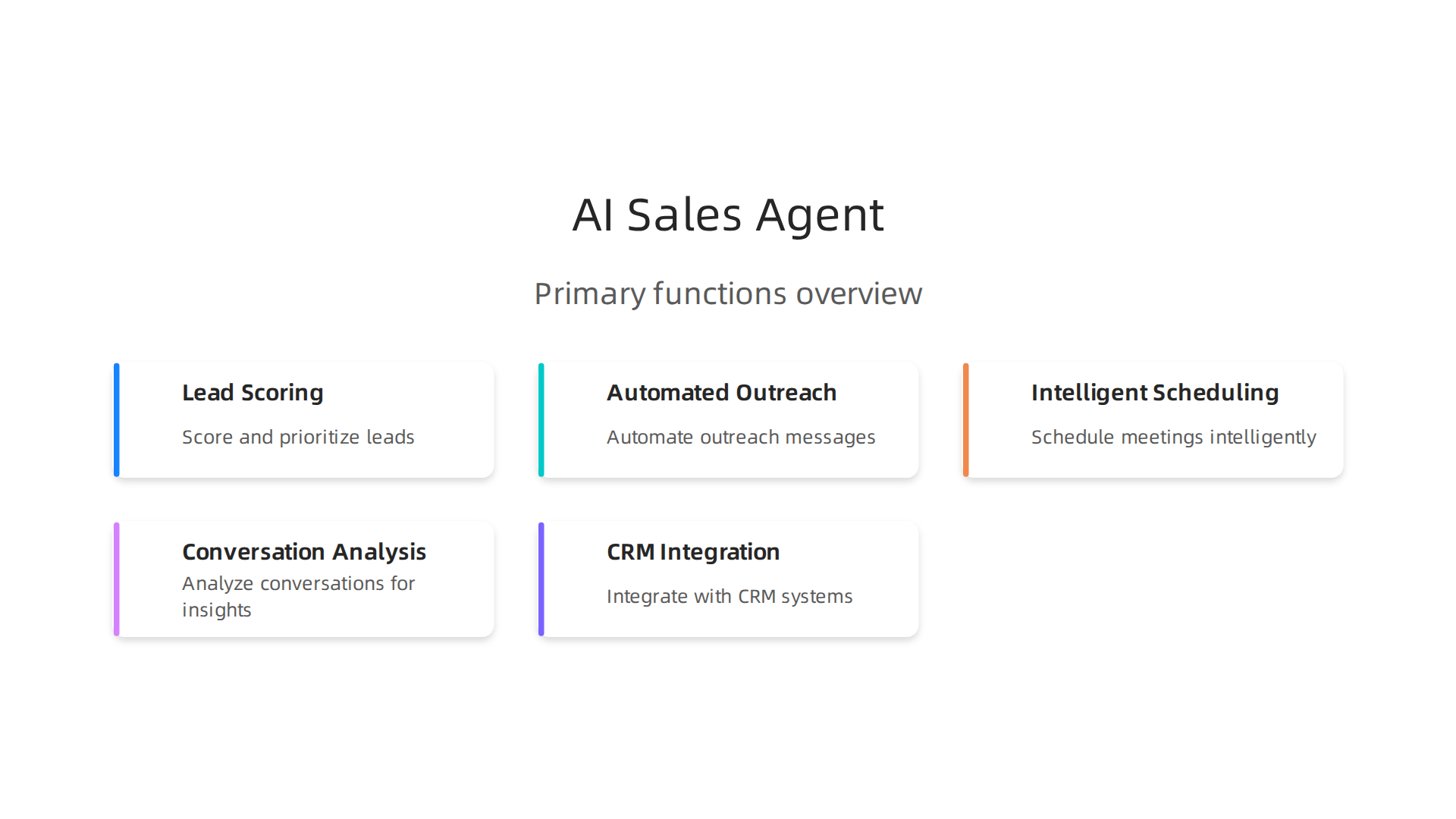
Primary Functions of an AI Sales Agent
- Lead Scoring and Prioritization: It analyzes data from your CRM, website, and emails to predict which leads are most likely to buy. Instead of you guessing, it tells you who to call first.
- Automated Initial Outreach: It can send personalized, context-aware emails or messages to new leads to start a conversation, book a meeting, or deliver specific information, following up automatically.
- Intelligent Meeting Scheduling: By connecting to your calendar, it can negotiate meeting times with prospects via chat or email, eliminating the frustrating back-and-forth.
- Conversation Analysis: After a call, it can transcribe the conversation, analyze the sentiment, and highlight key discussion points, objections, or next steps for you to review.
- CRM Integration and Updates: This is a critical function. A true AI sales agent seamlessly integrates with systems like Salesforce or HubSpot. It can automatically log activities, update contact records, and create tasks based on what it learns from your interactions, keeping your CRM accurate without manual data entry.
The goal is not to replace you. The goal is to remove the friction and busywork. By handling these tasks, an AI agent gives you more time to build relationships, negotiate complex deals, and provide the strategic advice that clients truly value. As adoption of this technology continues to grow globally, understanding these capabilities is the first step to using them effectively in your own career.
Key Technologies Behind AI Sales Agents
So, how does an AI sales agent actually do all that helpful work? It’s powered by a combination of smart technologies.
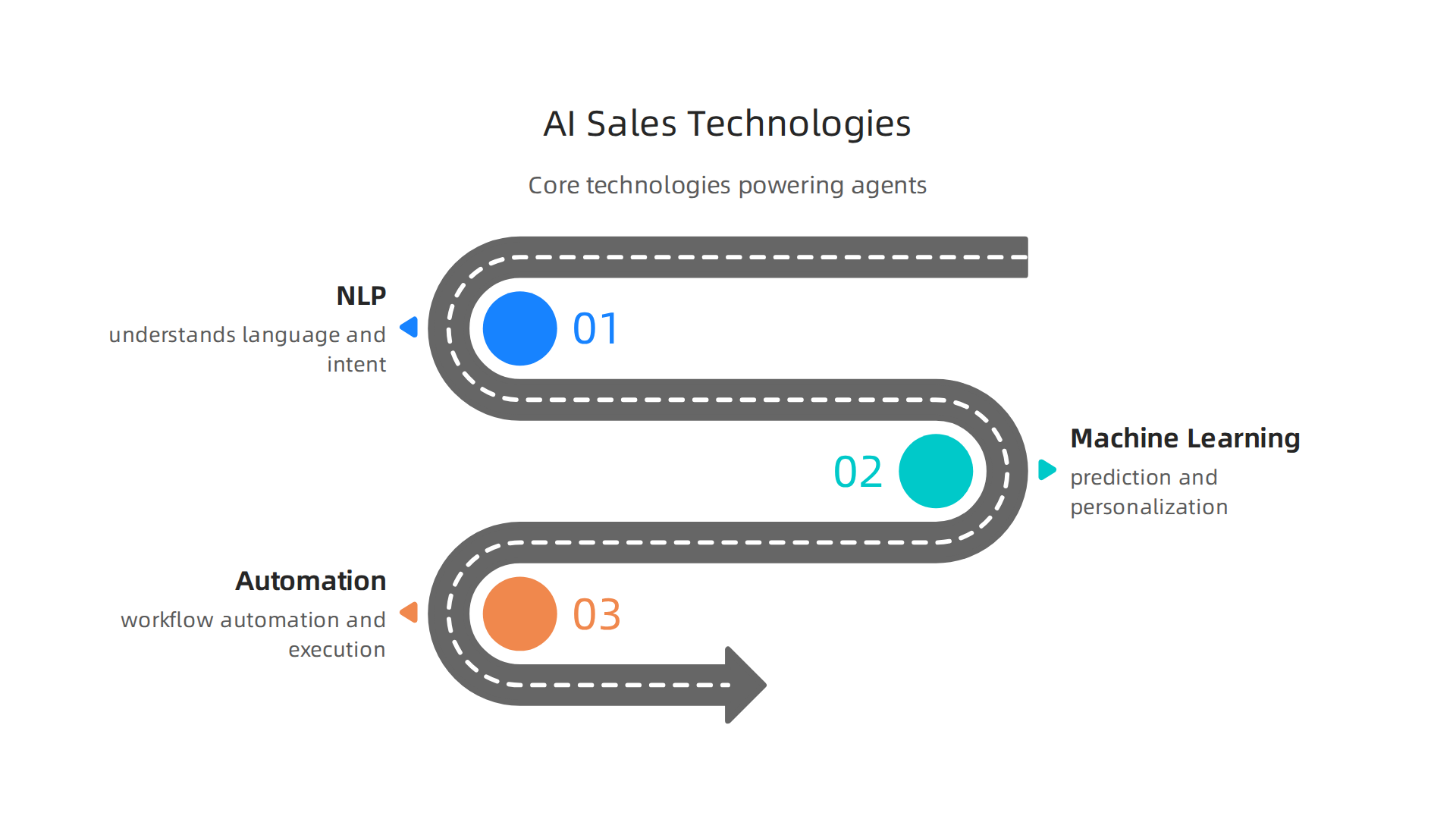
Understanding the basics helps you see it as more than magic. It’s a practical tool built on a few key innovations.
First, there’s Natural Language Processing, or NLP. This is what lets the AI understand and use human language. When you ask an AI to write an email or when it reads a prospect’s reply, NLP is at work. It allows for realistic conversations, not just robotic scripts. This makes the interaction feel helpful, not forced.
Next is Machine Learning. This is the engine for prediction and personalization. The AI studies your past sales data to learn patterns. Over time, it gets better at predicting which leads are hot. It uses this learning to personalize outreach, suggesting the right message for the right person at the right time. Analysts at Gartner have highlighted that this kind of predictive, agentic AI is surging in adoption, with use expected to grow dramatically by 2027.
Finally, these technologies work together to automate repetitive tasks. NLP understands the request. Machine learning decides the best action based on data. Then, the system executes it. This loop is what automatically scores leads, schedules meetings, or logs notes in your CRM. It turns smart analysis into real-world action.
Together, NLP and machine learning transform simple automation into an intelligent AI assistant. It’s these core technologies that allow modern AI tools to handle the routine work, giving you back your most valuable resource, your time.
The Real Impact on Sales Jobs and Career Paths
It is a natural question in 2026. If I use an AI sales agent, will it eventually take my job? Here is the good news. The overwhelming consensus from business leaders and researchers is clear. AI is not here to replace salespeople. It is here to make them far more effective. The real story is about augmentation, not elimination.
Think of it this way. An AI assistant handles the routine, time-consuming work. This frees you up to focus on what you do best. Complex negotiation. Building deep, trusting relationships. Strategic problem-solving for your clients. These are deeply human skills that machines cannot replicate.

As research from Boston Consulting Group confirms, AI is set to reshape far more jobs than it replaces, with over 50% of roles being transformed in the next few years. For sales professionals, this transformation is a massive opportunity.
Which Tasks Are Being Automated?
So, what is the AI handling? These are the repetitive, data-heavy tasks that often feel like busywork:
- Prospecting and Lead Scoring: The AI can scan databases and signals to identify and rank the most promising leads, so you talk to the right people first.
- Initial Outreach and Follow-ups: It can send personalized, templated emails or messages to start conversations and nurture leads until they are sales-ready.
- Data Entry and CRM Updates: The tool automatically logs calls, emails, and notes into your customer relationship system. You never have to manually update a record again.
- Scheduling and Meeting Prep: It can coordinate calendars to book meetings and even provide you with a brief on the prospect right before the call.
By automating these tasks, the AI sales agent acts like a super-powered intern. It handles the groundwork so you can step in for the high-value pitch.
The Evolution of the Sales Role
This shift is actively changing job descriptions. The salesperson of 2026 is less of an information broadcaster and more of a strategic consultant. Your value is shifting from "who can make the most calls" to "who can build the best relationships and close the most complex deals." Employers are now seeking skills like emotional intelligence, strategic thinking, and business acumen, alongside the ability to manage and interpret AI-generated insights.
New Hybrid Roles on the Horizon
This change is also creating exciting new career paths at the intersection of sales, data, and technology. We are seeing the emergence of roles like:
- Sales Technologist: A professional who manages the sales tech stack, optimizes AI tools like PolyBuzz AI, and ensures the sales team has the right data to win.
- AI Sales Strategist: Someone who designs the rules and workflows for the AI, teaches it the best sales practices, and analyzes its performance to improve results.
- Data-Driven Sales Manager: A leader who uses AI analytics to coach their team, forecast more accurately, and make strategic decisions based on deep market insights.
These roles require a blend of sales intuition and technical comfort. They represent a career growth path for sales professionals who embrace these new AI tools.
The message for 2026 is one of empowerment. As noted by Harvard Business School, demand is growing for jobs that require analytical and creative work enhanced by AI. By letting an AI sales agent handle the routine, you invest your energy in the complex, human-centric work that drives real revenue and builds lasting careers. The future belongs to the salesperson who partners with AI, not the one who fears it.
Future-Proof Skills: What Human Sales Pros Need to Master
Now that you know an AI sales agent is your partner, not your replacement, a new question emerges. What skills should you focus on to make sure you stay in demand? With over 50% of jobs being reshaped by AI in the coming years, according to a Boston Consulting Group analysis, your unique human abilities are more valuable than ever.
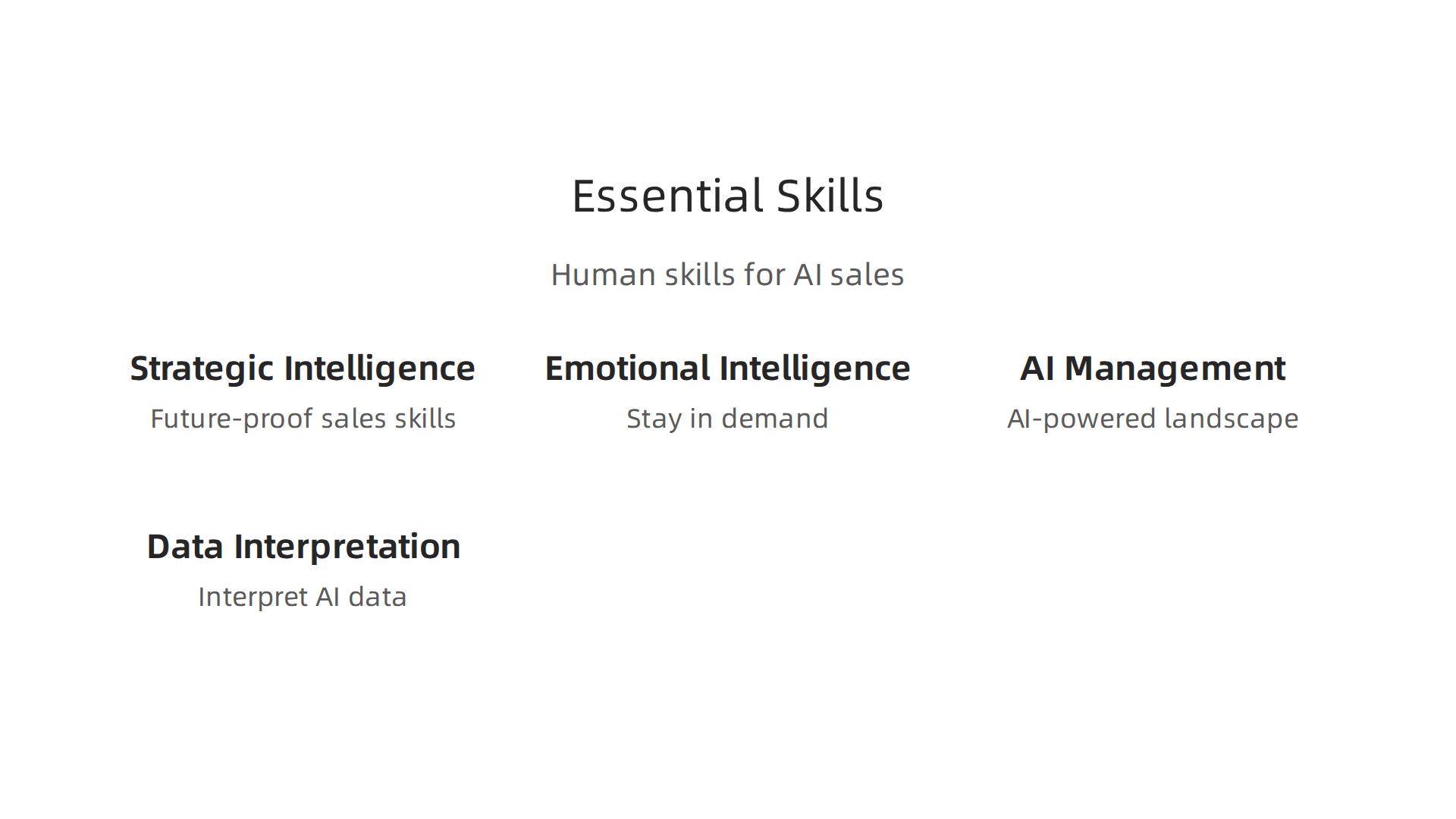
The goal is to master the skills that an AI cannot replicate and learn how to manage the AI tools that can. Here is your 2026 skill-building roadmap.
Strategic and Emotional Intelligence
This is your superpower. While an AI assistant can analyze data, it cannot feel empathy, navigate complex human emotions, or build genuine trust. Your future success hinges on skills like:
- Complex Problem-Solving: Moving beyond simple product pitches to understanding a client’s deeper business challenges and co-creating strategic solutions.
- Building Deep Trust and Rapport: Reading body language, sensing hesitation, and creating a connection that makes a client feel understood and secure.
- High-Stakes Negotiation: Navigating nuanced discussions where relationship, value, and compromise are balanced in real-time.
These are the areas where you provide irreplaceable value. As research from Harvard Business School notes, employer demand is surging for jobs that require more analytical and creative work enhanced by AI. Your emotional intelligence is the creative engine that turns AI’s data into human connection.
AI Management and Prompt Engineering
Think of this as becoming a skilled coach for your AI tools. You do not need to be a programmer, but you must know how to communicate with AI effectively to get the best results. This means:
- Guiding the AI: Setting clear goals and parameters for your AI sales agent. For example, teaching it your company’s unique value proposition so its outreach sounds authentic.
- Asking the Right Questions (Prompting): Learning how to ask AI for specific insights, like "Analyze this prospect’s recent company news and suggest three conversation starters about their likely challenges."
- Interpreting and Refining Output: The AI gives you raw material; you refine it. You review its drafted emails for tone, check its lead scores for intuition gaps, and use its data to inform your human strategy.
Mastering this turns the AI from a simple automation tool into a true collaborative partner that amplifies your efforts.
Data Interpretation and Storytelling
Your AI sales agent will hand you a dashboard full of metrics, trend lines, and lead scores. Your job is to turn that data into a compelling story. This skill bridges the gap between cold numbers and warm conversations.
- Translating Insights: You see that a lead scored highly because they visited your pricing page three times. The story you craft is about addressing their specific budget concerns and demonstrating clear ROI.
- Creating Customer-Centric Narratives: Instead of saying "Our product has X feature," you use data to say, "I noticed your team struggles with Y. Here’s how clients like you used our solution to solve it, and here’s the data that proves it worked."
- Informing Strategy: You use AI-generated market insights to advise your company on new opportunities or to tailor your sales approach for different segments.
This ability to find the human meaning in the machine’s data is what separates a good salesperson from a strategic consultant. In 2026, the most successful sales professionals will be those who blend deep human understanding with the power to guide and interpret AI, ensuring they remain at the heart of every deal that matters.
Navigating Your Career Path: Tailored Advice for Every Stage
Your career in sales looks different depending on where you’re standing right now. Are you looking for your first break, aiming to climb higher where you are, or considering a switch into this exciting field? No matter your starting point, understanding how to partner with an AI sales agent is now a core part of the journey. Here is your tailored guide for 2026.
For Job Seekers: Spotting the Right Opportunities
If you’re hunting for a new sales role, the companies that use AI tools well are often the best places to work. They’re usually more efficient, data-driven, and focused on empowering their teams rather than replacing them. Here’s how to find them and stand out.
How to Identify Forward-Thinking Companies:
- Listen for the Right Buzzwords: In job descriptions, look for phrases like "AI-powered CRM," "sales enablement tech," or "data-driven coaching." These signal a tech-forward environment.
- Ask Strategic Interview Questions: Turn the tables. Ask, "How does the sales team currently use AI or automation to augment their workflow?" or "What AI tools are provided to help understand customer needs?" Their answer tells you about their investment in your success.
- Research Their Tech Stack: A quick look on LinkedIn or the company website can often reveal if they use modern platforms where an AI assistant is common.
How to Frame Your Skills:
Your application should highlight the human skills that AI lacks, positioning you as the perfect partner for their tech. Don’t just say you’re a "people person." Show it.
- Highlight Complementary Skills: Focus on your experience with complex problem-solving, building client rapport, and strategic negotiation. These are the irreplaceable human edges.
- Show Basic AI Literacy: Mention any familiarity with CRM systems, data analysis, or even prompt engineering courses. It shows you’re ready to learn and collaborate. As research on AI tools for upskilling shows, personalized learning is key to adapting quickly in modern workplaces.
- Frame Yourself as an Adaptor: Emphasize your ability to learn new systems and use tools to work smarter. Companies adopting AI sales training, as seen in industry case studies, are looking for adaptable professionals who embrace new methods to win.
For Current Sales Professionals: Audit and Upskill
You’re already in the game. Your mission is to proactively future-proof your current role and become indispensable. Think of this not as a threat, but as a chance to elevate your strategic value.
Conduct a Personal Automation Audit:
Take a clear-eyed look at your daily tasks. Which are repetitive and data-heavy? Those are likely being augmented or automated by an AI sales agent. Your goal is to own the tasks that come after the automation.
- List Your Core Tasks: Make a simple list of everything you do in a week.
- Identify the "Augmentable": Circle tasks like lead scoring, initial email outreach, scheduling, and basic data entry. These are prime for AI partnership.
- Claim the "Irreplaceable": Highlight tasks like handling complex objections, navigating high-value negotiations, building executive relationships, and interpreting data insights to craft strategy. This is your growth zone.
Proactively Seek Upskilling:
Once you know your growth zone, seek out learning opportunities. A McKinsey report on AI upskilling frames this as a necessary change journey for lasting career strength.
- Internal Training: Ask your manager about courses on data storytelling, advanced CRM features, or prompt engineering. Many companies, following the lead of firms like PepsiCo, now use AI platforms to identify and fill skill gaps for career mobility.
- Learn to "Ask AI" Effectively: Dedicate time to learn prompt engineering for sales. Practice getting better insights from your tools. A guide like the one on AI in sales careers and leadership can clarify what skills are now most valued.
- Volunteer for Pilot Programs: If your company is testing new AI tools, be the first to raise your hand. This positions you as an innovator and gives you early experience.
For Beginners & Career Switchers: Build a Smart Foundation
Starting fresh in 2026 is a unique advantage. You can build a foundational skill set that includes AI literacy from day one, making you a attractive candidate for modern teams.
Build These Foundational Skills:
- Sales Fundamentals: Understand the basic sales cycle, objection handling, and value proposition crafting. These human-centric skills are timeless.
- Basic Data Literacy: Get comfortable reading charts and understanding basic metrics. Know what KPIs like conversion rate and pipeline value mean.
- Digital Communication: Master clear, concise writing for emails and virtual meetings. This is crucial whether you’re working with a human or guiding an AI assistant.
- AI Tool Familiarity: Explore free versions of common sales and marketing tools. Get a sense of how technology supports the process. Resources discussing the transformation of corporate learning by AI highlight how pervasive this shift is.
Where to Find Entry-Level Roles That Use AI:
Look for positions that are gateways to working with advanced tools.
- Sales Development Representative (SDR): This role often uses AI-powered dialers, email sequencing tools, and lead scoring the most. It’s a fantastic place to learn the tech.
- Customer Success Associate: Supporting customers after the sale increasingly uses AI chatbots and health score platforms, giving you exposure to AI-driven insights.
- Inside Sales Representative: Many inside sales teams are heavily supported by conversation intelligence software and AI coaching tools to improve performance, as seen in modern sales training case studies.
No matter your stage, the path forward involves partnership. Your career in sales is no longer just about your individual pitch. It’s about how effectively you can combine your unique human strengths with the power of AI to create more value. Start where you are, use the strategy that fits your stage, and build the career that will thrive in 2026 and beyond.
Finding Legitimate Opportunities and Avoiding Pitfalls
In 2026, the promise of working with an AI sales agent is attracting many to the field. But with new opportunities come new ways for bad actors to disguise old scams. Your excitement for a tech-forward role shouldn’t blind you to the warning signs. The key is knowing how to spot a legitimate, AI-enhanced sales career versus a repackaged, exploitative scheme.
Red Flags: Is It a Real Job or a Disguised Scheme?
Many questionable operations now use buzzwords like "AI-powered" or "tech-enabled" to appear modern. Here are critical red flags to watch for.
- The Focus is on Recruiting, Not Selling: If the interview or job description talks more about building a "team" or "downline" than about selling a tangible product to real customers, be very cautious. As the FTC warns, some illegal pyramid schemes masquerade as multi-level marketing businesses, where money comes primarily from recruiting others.
- You Have to Pay to Start: Legitimate sales jobs provide you with tools and training. If you’re asked to pay for a "starter kit," "mandatory training software," or access to a sales portal upfront, it’s a major warning sign. A video guide for new agents highlights that being asked to pay for your own leads or software is a classic red flag in disguised MLM setups.
- Vague or Over-the-Top Income Claims: Promises of easy, fast money with little effort are hallmarks of scams. Real sales roles with AI tools are about working smarter, not about getting rich overnight. Be skeptical of claims that the business plan is "government-approved" or similarly grandiose, as officials note such claims should themselves be a bright red flag.
- No Base Salary, Only Commission on Recruitment: While commission-only roles exist in legitimate sales, the commission should be for selling products. If the primary or most lucrative commission comes from recruiting other salespeople, you’re likely looking at a pyramid scheme model.
Key Questions to Ask in Your Interview
Turn the tables and interview them back. Your questions can reveal their true priorities.
- "Can you walk me through the primary product or service I’d be selling, and who the typical customer is?" This forces clarity on whether there’s a real product for real customers.
- "What specific AI tools will I be provided, and what training is offered to use them effectively?" Legitimate companies invest in your proficiency. Vague answers about "our proprietary platform" are suspect.
- "What does the typical career path look like for a top performer here, and what are the key performance metrics?" Listen for answers about customer growth, deal size, and client retention, not team size.
How to Research a Company Before Applying
A little homework can save you from a big headache.
- Search Beyond the Company Website: Look for reviews on Glassdoor and comments on forums like Reddit’s r/sales. Search the company name alongside terms like "MLM," "pyramid scheme," or "scam."
- Investigate the "Tech Stack": Use LinkedIn to see if real employees list credible AI assistant platforms like Gong, Salesforce Einstein, or Outreach on their profiles. If their "tech" is just an internal recruiting portal, that’s a clue.
- Check for Regulatory Warnings: Search the company name on the website of the Better Business Bureau (BBB) or your local consumer protection office, like the State of Michigan’s site, which provides clear alerts on investment and marketing schemes.
Remember, a true AI sales agent role empowers you to sell better. It doesn’t ask you to pay to play, recruit your friends, or chase phantom customers. By asking sharp questions and doing your research, you can confidently find a role where technology amplifies your talent, not one that exploits your ambition.
Upskilling and Training Resources for the AI-Powered Sales Era
So you’ve found a legitimate opportunity to become an AI sales agent. Great. Now, the real work begins. In 2026, having the job isn’t enough. The most successful agents are the ones who commit to lifelong learning. The tools are smart, but they need a skilled human partner. Your new goal is to build the knowledge and skills that turn a good AI assistant into a great one.
Here is how you can build your own training plan with the best resources available today.
Start with the Right Courses and Certifications
You don’t need to become a computer scientist. You need to understand how AI tools work in a sales context. Focus on courses that blend business strategy, data basics, and practical application.
Many top institutions now offer programs designed for professionals like you. For example, Kellogg School of Management offers an Advanced Certificate in Sales and AI Business Strategies, a five month program focused on strategy. For a broader foundation, the Google AI Essentials course on Coursera is a popular and free starting point that covers AI basics and prompt design.
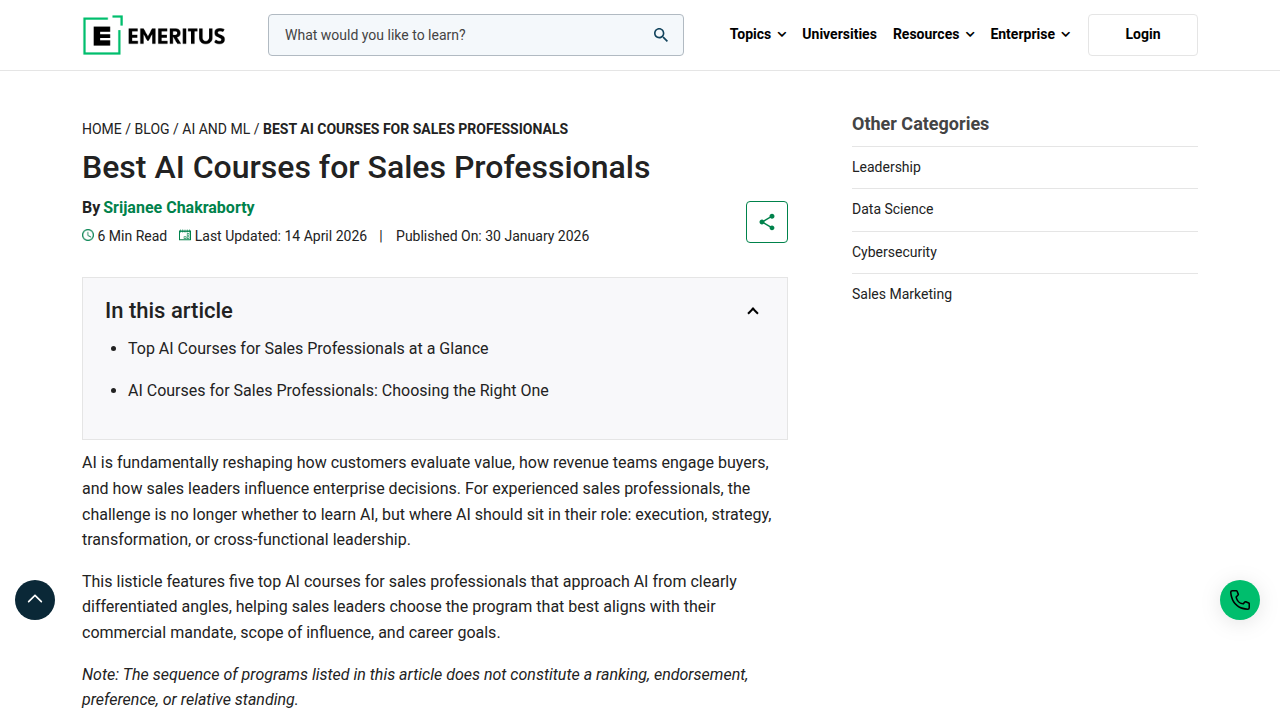
When choosing, look for programs that promise practical outcomes. A good course should help you improve pipeline management, lead scoring, and forecasting. You can find detailed guides comparing the best AI courses for sales professionals to see what fits your current level and goals.
Learn from Your Peers in Professional Communities
You are not building this skillset alone. Some of the best insights come from other salespeople who are using these tools every day.
Make it a habit to visit online communities. Platforms like LinkedIn are essential for following thought leaders and product experts. Join groups focused on sales technology or specific platforms like Salesforce or Gong. For unfiltered advice, forums like Reddit’s r/sales are invaluable. Here, you can ask AI specific questions, share challenges with tools like Polybuzz AI, and get real world feedback on what works.
The goal isn’t just to lurk. Share your own wins and lessons. Teaching a concept to someone else is one of the fastest ways to master it yourself.
Build Your Personal Learning Plan
Waiting for your company to train you is a slow strategy. The best agents are proactive. Create a simple, self directed plan you can follow each week.
Here is a basic framework to start with:
- Month 1: Foundations. Dedicate 2-3 hours per week. Complete an introductory AI course. Follow five new industry experts on LinkedIn.
- Month 2: Your Tech Stack. Spend 1-2 hours weekly. Deeply learn one AI tool you use at work. Watch all its tutorial videos. Join its user community.
- Month 3: Data Literacy. Use 1 hour per week. Learn to read your basic sales dashboards. Understand what key metrics like lead conversion rate and pipeline velocity really mean.
- Ongoing: Weekly Community Time. Block 30 minutes every Friday to scroll through your professional networks. Save one useful article or tip.
The landscape of sales training is always evolving. A recent review of the 15 best sales training platforms in 2026 can help you find the next step in your journey, from full learning management systems to specialized coaching programs.
Remember, upskilling isn’t a one time event. It is the habit that will keep you relevant and effective. By mixing formal education, community knowledge, and a personal commitment to grow, you will not just keep up with the AI powered sales era. You will lead in it.
The Future Outlook: Where AI in Sales is Headed Next
What happens after you’ve built your skills? The future is already here, and it’s changing fast. By 2026, using an AI sales agent isn’t a fancy trick. It’s standard practice. Adoption rates have surged, with nearly 90% of businesses now using some form of AI according to a recent industry report. The question is no longer if you will use these AI tools, but how they will reshape your entire career.
The Next Wave of Trends
Two major trends are defining the near future. First is hyper personalization at scale. Imagine your AI assistant crafting unique video messages, tailoring product demos in real time, and suggesting offers based on a lead’s recent online activity. This level of one to one attention, but for thousands of leads, is becoming possible. The second trend is AI driven sales coaching. Platforms will analyze your call recordings, not just for keywords, but for tone, pacing, and emotional cues.

They will then offer specific feedback, like a personal trainer for your sales conversations.
These aren’t distant ideas. A 2025 survey of enterprise AI use cases showed a clear pivot, with sales enablement and CRM automation now leading the way. We are moving from simple task automation to intelligent partnership.
The Human Guardrails: Ethics and Oversight
With great power comes great need for careful control. As processes become more automated, ethical considerations are crucial. Who is responsible if an AI makes a promise the company can’t keep? Could bias in training data lead to unfair targeting?
This is why human oversight is non negotiable. Your role evolves from doing the repetitive work to managing the intelligence. You approve final messages, you interpret nuanced emotional signals the AI might miss, and you ensure every interaction aligns with your company’s values. Think of yourself as the conductor, ensuring the whole system works in harmony. Analysts predict a significant increase in the use of autonomous AI agents, making this oversight role more critical than ever.
Your Career with a Permanent Partner
So, what does long term career planning look like? It means viewing AI not as a temporary tool, but as a permanent partner in your success. The most successful sales professionals in 2026 won’t compete with their AI sales agent. They will collaborate with it.
Your unique human skills empathy, complex negotiation, creative problem solving, and building deep trust become your superpowers. The AI handles the data, the scale, and the initial outreach. You focus on the high touch, high value moments that close deals and build lasting relationships.

This partnership frees you to be more strategic and consultative.
The landscape is evolving faster than ever, as noted in the latest Stanford AI Index Report which tracks this rapid change. By embracing this future, you secure your place in it. You stop just using technology and start truly working with it. That is how you build a future proof sales career.
Summary
This guide explains what AI sales agents are, how they work, and why they matter for anyone working in sales today. It describes core capabilities—like lead scoring, automated outreach, meeting scheduling, conversation analysis, and CRM updates—and the technologies behind them, such as NLP and machine learning. The article shows how AI augments rather than replaces salespeople, highlights which routine tasks are most likely to be automated, and outlines new hybrid roles that blend sales and tech. It gives practical career advice for job seekers, current professionals, and beginners, including how to spot scams and research employers. Lastly, it lays out a concrete upskilling plan and ethical guardrails so readers can partner with AI effectively and future‑proof their sales careers.